
Download, print, and complete the Patient Assistance Program (PAP) Enrollment Form and fax to 1-855-299-8746 or email to info@anzupgoletsgo.com
ON Tricare, United Healthcare, Cigna, Express Scripts, & Optum
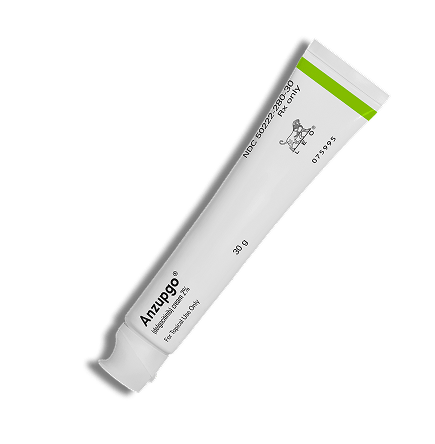
Not actual size.
Apotheco Pharmacy Group
Phone: 1-973-870-0544
Fax: 1-973-870-0544
NCPDP ID: 3153258

Carepoint Pharmacy
Phone: 1-855-237-9112
Fax: 1-855-237-9113
NCPDP ID: 1487330

DFW Wellness Pharmacy
Phone: 1-817-459-8400
Fax: 1-817-459-8402
NCPDP ID: 5903491
Review key information to prevent delays in getting your patients started on ANZUPGO.
Patients can be enrolled by the pharmacy and may receive a limited supply of ANZUPGO at no cost.
Patients are automatically enrolled by the pharmacy and may pay as little as $0 per 30 g tube.
For pharmacies only
*Eligible, commercially insured patients may pay as little as $0 per 30 g tube through the ANZUPGO Copay Program. See full Terms, Conditions, and Eligibility Rules.†Eligible, commercially insured patients may be able to receive a limited supply of ANZUPGO at no cost. See full Terms, Conditions, and Eligibility Rules.
ANZUPGO Patient Assistance Program (PAP):
Helps patients with demonstrated financial need and limited or no prescription coverage.
Connect with the ANZUPGO® Let's GOTM Support Program to learn more.
For your eligible patients with demonstrated financial need and limited or no prescription coverage, ANZUPGO can be dispensed through the ANZUPGO® Let's GOTM Support Program.

Help your patients access ANZUPGO
Ready to prescribe ANZUPGO?
Include the key information below to prevent delays in getting your patients started on ANZUPGO:

Remember to include an ICD-10-CM code. There is no approved ICD-10-CM code for CHE. Examples of ICD-10-CM codes that may be used include§:
Atopic dermatitis: L20.89, L20.9
Allergic contact dermatitis: L23.0-L23.9
Irritant contact dermatitis: L24.0-L24.B3
Protein contact dermatitis: L25.0-L25.9
Acute, recurrent vesicular (dyshidrosis): L30.1
Hand dermatitis: L30.8
ANZUPGO Rx Instructions resource
ICD-10-CM=International Classification of Diseases, 10th Revision, Clinical Modification; TCS=topical corticosteroids.
§The coding information in this resource is provided for informational purposes only and is subject to change. The ICD-10-CM codes listed may not apply to all patients or to all health plans; it is the responsibility of the healthcare provider to select the appropriate ICD-10-CM code(s) and submit claims that accurately reflect the services and products furnished to a specific patient.
Need to request a medical exception or submit a prior authorization for ANZUPGO?
Support is available to help you and your office staff identify and understand different payer process requirements across various insurance plan types, so you can accurately respond to prior authorizations (PAs) and denials.
PA denied? Here’s what to do next:
ANZUPGO is indicated for the topical treatment of moderate to severe chronic hand eczema (CHE) in adults who have had an inadequate response to, or for whom topical corticosteroids are not advisable.
Limitations of Use: Use of ANZUPGO in combination with other JAK inhibitors or potent immunosuppressants is not recommended.
WARNINGS AND PRECAUTIONS
Serious Infections: ANZUPGO may increase the risk of infections. Eczema herpeticum was observed in a subject treated with ANZUPGO. Serious and sometimes fatal infections have been reported in patients receiving oral or topical JAK inhibitors. Avoid use in patients with an active or serious infection. Consider risks and benefits before initiating ANZUPGO in patients with chronic or recurrent infection; tuberculosis exposure; history of serious or opportunistic infection; or underlying conditions that may predispose to infection. Monitor for signs and symptoms of infection during and after treatment. Interrupt ANZUPGO if a serious infection develops; do not resume until the infection resolves or is adequately treated.
Viral reactivation, including herpes virus reactivation (e.g., herpes zoster), was reported in clinical trials with ANZUPGO. If herpes zoster develops, consider interrupting ANZUPGO until the episode resolves. The impact of ANZUPGO on chronic viral hepatitis reactivation is unknown; consider viral hepatitis screening and monitoring per clinical guidelines before and during therapy. If signs of reactivation occur, consult a hepatitis specialist. ANZUPGO is not recommended in patients with active hepatitis B or C.
Non-melanoma Skin Cancers: Non-melanoma skin cancers, including basal cell carcinoma, have been reported. Periodic skin examinations of application sites are recommended for all patients, particularly for patients with risk factors for skin cancer. Advise patients to avoid sunlamps and minimize sunlight exposure.
Immunizations: Prior to ANZUPGO, complete all age-appropriate vaccinations per current immunization guidelines, including herpes zoster vaccinations. Avoid live vaccines immediately prior to, during, and immediately after ANZUPGO treatment.
Potential Risks Related to JAK Inhibition: It is not known whether ANZUPGO may be associated with the observed or potential adverse reactions of JAK inhibition. In a safety trial of an oral JAK inhibitor with methotrexate in RA, patients ≥50 years with ≥1 cardiovascular risk factor had higher rates of all-cause mortality (including sudden cardiovascular death), MACE, overall thrombosis, DVT, PE, and malignancies (excluding non-melanoma skin cancer) versus TNF blockers.
ANZUPGO is not indicated for use in rheumatoid arthritis (RA). Oral and topical JAK inhibitors have been associated with increased lipids (total cholesterol, LDL cholesterol, triglycerides). Oral JAK inhibitors have caused hypoglycemia in patients with diabetes.
Adverse Reactions
Adverse reactions reported in ≤1% of subjects were application site pain, paresthesia, pruritus, erythema, and bacterial skin infections, including finger cellulitis, paronychia, other skin infections, leukopenia, and neutropenia.
Use in specific populations
Lactation: To minimize potential infant exposure, advise breastfeeding women to avoid direct contact with the nipple and surrounding area immediately after applying ANZUPGO to the hands and/or wrists.
1. ANZUPGO. Prescribing information. LEO Pharma Inc. 2. Silverberg JI, et al. Am J Clin Dermatol. Published online February 8, 2026. doi:10.1007/s40257-026-01008-3 3. Bissonette R, et al. Lancet. 2024;404(10451)(supplement):1-33. doi:10.1016/S0140-6736(24)01027-4